The way we read books has changed. A reader can pick up a hardcover at home, open an ebook on a phone during a trip, or listen to an audiobook while driving to work. The story may be the same, but the experience can feel completely different.
So, which format is best in 2026: print, ebooks, or audiobooks?
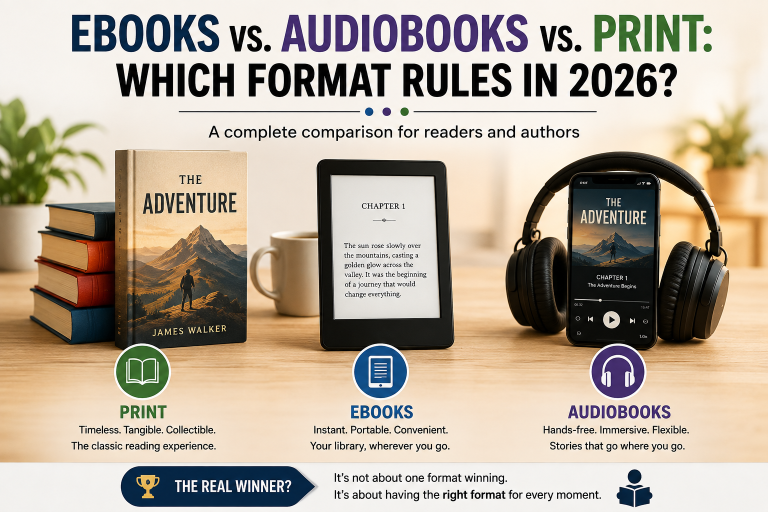
The answer isn’t as simple as choosing one winner. Each format has its own strengths. Print offers a physical experience. Ebooks offer convenience and portability. Audiobooks give readers the freedom to enjoy a story without looking at a page.
For authors, the decision matters even more. Choosing the right format can affect how a book reaches readers, how much it costs to produce, and how it fits into a larger publishing strategy.
Modern publishing is no longer about choosing only one format. Many authors are finding value in offering readers more than one way to experience their books.
If you’re exploring your own publishing options, you can also learn more about Frontline Publishing and the services available to authors.
The Publishing Landscape in 2026
Books are no longer limited to the traditional printed page.
A single title can now appear as a hardcover, paperback, ebook, and audiobook. Readers can choose the version that works best for their lifestyle.
Print books continue to have a strong place in the market. Current 2026 data from Circana shows that physical books remain an important part of book buying, with print bestsellers spanning fiction, children’s books, romance, science fiction, and other categories.
At the same time, audiobooks are growing quickly. The Audio Publishers Association reported that U.S. audiobook revenue reached $2.43 billion in 2025, up 9% from the previous year. It also reported that 58% of Americans aged 18 and older have listened to an audiobook.
Ebooks remain an important part of digital reading because they give readers instant access without requiring a physical copy.
This means authors have more choices than ever.
Why Authors Are Moving Toward Multi-Format Publishing
Imagine you’ve written a novel.
One reader wants a hardcover for their bookshelf. Another wants an ebook because they’re traveling. A third prefers an audiobook because they spend an hour commuting every day.
They’re all interested in the same story.
Why make them choose only one way to experience it?
Publishing in multiple formats can help authors reach different audiences while giving readers more control.
If you’re researching a publisher, it can also help to look at real author experiences. You can explore Frontline Publishing Reviews to see how authors describe their publishing experiences.
Print Books: Why Physical Books Still Matter
There was a time when people wondered whether ebooks would eventually replace printed books.
That hasn’t happened.
Print remains important because a physical book offers something digital formats can’t fully reproduce: the feeling of actually owning and holding a book.
Advantages of Print Books
One of the biggest benefits is the physical experience.
You can hold a printed book, turn its pages, place it on a shelf, lend it to a friend, or give it as a gift.
Print books are also valuable for collectors. A signed copy, special edition, or beautifully designed hardcover can become something a reader keeps for years.
Print is particularly useful for children’s books and illustrated books. Color, artwork, page design, and physical interaction can be an important part of the experience.
And there’s one simple benefit that shouldn’t be overlooked: a printed book doesn’t need a battery.
You can read it on a beach, on a plane, in bed, or in a quiet park without worrying about charging a device.
Disadvantages of Print
Print has some practical disadvantages.
Books cost money to print. They also need to be shipped, stored, and sometimes kept in inventory.
A reader traveling with five large books has a very different experience from someone carrying five ebooks on a phone.
Physical books also take up space.
Who Should Choose Print?
Print can be a strong choice for:
- Collectors
- Gift buyers
- Children’s books
- Illustrated books
- Special editions
- Signed books
- Readers who simply love physical books
For many authors, print is also an important part of book events and author signings.
Ebooks: Convenience and Digital Accessibility
Ebooks changed the way many people carry and access books.
Instead of filling a suitcase with books, you can carry an entire digital library on one device.
Advantages of Ebooks
Instant access is one of the biggest benefits.
When an ebook is available digitally, readers can often purchase it and begin reading without waiting for printing or shipping.
Ebooks are also portable. Your phone, tablet, or e-reader can hold many titles without taking up physical space.
Another useful feature is adjustable text. Depending on the device and reading software, readers can often change font size and other display settings.
Search and highlighting can also make ebooks useful for research, study, and reference.
For people who travel frequently, ebooks can be especially convenient.
Disadvantages of Ebooks
Ebooks aren’t perfect for everyone.
You need an electronic device to read one, and that device needs power.
Some people also find that reading from a screen isn’t as relaxing as reading printed pages.
And while an ebook gives you access to a story, it doesn’t provide the same physical feeling as holding a book.
Who Should Choose Ebooks?
Ebooks are particularly useful for:
- Frequent travelers
- Digital-first readers
- Fiction readers
- Readers who want instant access
- People who prefer carrying a digital library
- Readers who like search and highlighting tools
For authors, ebooks can also be a practical way to make a book available to digital audiences.
Audiobooks: A Major Part of Modern Publishing
If print is about holding a story and ebooks are about carrying a story, audiobooks are about listening to a story wherever you are.
And audio is having a major moment.
The Audio Publishers Association reported more than 750,000 active audiobook titles in 2025, a 43% increase from 2024. Its 2026 consumer research also found that audiobook listeners value the ability to multitask and listen while on the go.
Why Readers Choose Audiobooks
Think about your daily routine.
Maybe you’re driving to work. Perhaps you’re walking the dog, cooking dinner, cleaning the house, or exercising.
You can’t always hold a book.
But you can listen.
That is one of the biggest advantages of audiobooks.
They allow readers to enjoy stories during activities that don’t leave their hands or eyes free.
Audiobooks can also provide another way for people to experience books when traditional reading is difficult or less convenient.
Why Narration Matters
A good audiobook isn’t simply someone reading words aloud.
The narrator can bring emotion, personality, rhythm, and character to the story.
A mystery can feel more suspenseful. A romance can feel more emotional. A children’s story can become more playful.
The narrator becomes part of the reading experience.
Audiobook Production for Authors
Creating an audiobook requires more than simply recording a manuscript.
Authors need to consider:
- Narrator selection
- Recording
- Editing
- Audio mastering
- Quality control
- Distribution
- Production costs
Authors considering audiobook production can explore the publishing and production options available through Frontline Publishing.
Ebooks vs. Audiobooks vs. Print: Side-by-Side Comparison
| Feature | Ebook | Audiobook | |
| Portability | Moderate | Excellent | Excellent |
| Convenience | Moderate | Excellent | Excellent |
| Hands-free use | No | No | Yes |
| Collectability | Excellent | Low | Low |
| Accessibility | Moderate | High | High |
| Production complexity | High | Lower | High |
| Physical experience | Excellent | No | No |
| Instant access | No | Yes | Yes |
The table makes one thing clear: there isn’t one format that wins every category.
The best choice depends on what the reader wants and what the author is trying to achieve.
Which Format Is Best for Authors?
Authors shouldn’t ask only, “Which format is most popular?”
A better question is:
Which format fits my audience, genre, budget, and goals?
When Print Makes Sense
Print can work especially well for:
- Children’s books
- Illustrated books
- Gift books
- Coffee-table books
- Collectible editions
- Signed books
If the visual or physical experience is important, print can be difficult to replace.
When Ebooks Make Sense
Ebooks can be a strong option for:
- Fiction
- Romance
- Mystery
- Science fiction
- Book series
- Digital-first readers
They are also useful for readers who want quick access and easy portability.
When Audiobooks Make Sense
Audiobooks can be especially useful for:
- Fiction
- Business books
- Self-help
- Memoirs
- Mystery and thrillers
- Long-form nonfiction
Audiobook demand is particularly notable in fiction. The Audio Publishers Association reported that fiction represented 71% of audiobook sales in 2025, with science fiction/fantasy, romance, and mystery/thriller/suspense among leading categories.
Choosing a publishing company is another important part of bringing a book to market. Reading genuine author experiences can help you make a more informed decision. Read Frontline Publishing Reviews
Should Authors Publish in All Three Formats?
For many authors, the answer can be yes.
Publishing in print, ebook, and audiobook gives readers choices.
One reader might buy a hardcover. Another might download the ebook. Someone else might listen to the audiobook.
The story doesn’t change. The experience does.
One Book, Three Reading Experiences
Picture an author releasing a new mystery novel.
A reader buys the hardcover and keeps it on the bookshelf.
Another reader downloads the ebook and reads it on vacation.
A third listener starts the audiobook during the morning commute.
All three people are enjoying the same book.
That’s the real strength of multi-format publishing.
Why Multi-Format Publishing Can Strengthen an Author’s Strategy
Different formats can reach different audiences.
They can also make a book more accessible and convenient.
The goal isn’t to force every reader into one format. It’s to give readers options.
You can learn more about the modern publishing journey through Frontline Publishing Reviews.
Comparing Publishing Costs
Cost is another important factor for authors.
Print Costs
Print publishing can involve:
- Editing
- Cover design
- Interior formatting
- Printing
- Shipping
- Inventory
The final cost can vary based on the book’s size, page count, paper, binding, print quantity, and other choices.
Ebook Costs
Ebooks don’t require physical printing or shipping.
However, authors still need to consider:
- Editing
- Cover design
- Ebook formatting
- Distribution
Audiobook Costs
Audiobooks can require additional production work, including:
- Narrator fees
- Recording
- Editing
- Mastering
- Distribution
The cheapest format isn’t automatically the best format.
Think about the audience first.
A format that costs more to produce may still be valuable if it reaches readers who wouldn’t otherwise buy the book.
Accessibility and Reader Preferences in 2026
Accessibility should be part of the publishing conversation.
Ebooks can offer adjustable text and digital reading features. Audiobooks provide a listening option for people who prefer audio or have difficulty reading traditional text. Print remains valuable for people who prefer physical pages and screen-free reading.
The important point is that different formats can serve different needs.
For authors, offering more than one format can make it easier for more people to experience a book.
Why Authors Should Think About Accessibility Before Publishing
Before choosing a format, ask yourself:
Who is my audience?
What might make this book easier to access?
Would some readers prefer audio?
Would others benefit from adjustable text?
Would a physical book provide a better experience?
These questions can lead to better publishing decisions.
Does Genre Determine the Best Book Format?
Genre doesn’t determine everything, but it can influence format preferences.
Fiction
Fiction can work well in all three formats. Readers may want a paperback, ebook, or audiobook depending on their lifestyle.
Romance
Romance readers can enjoy print, digital editions, and audio. Audiobooks can add another layer of emotion through narration.
Mystery and Thriller
Audiobooks can be particularly engaging for suspenseful stories. A skilled narrator can build tension and give characters distinct personalities.
Science Fiction and Fantasy
These genres can benefit from all three formats.
Print can create an attractive collectible edition. Ebooks are convenient for long series. Audiobooks can make imaginative worlds feel even more immersive.
Children’s Books
Print remains especially important for illustrated children’s books because pictures, page layouts, and physical interaction are often part of the experience.
Current Circana data also shows continued strength in children’s books and screen-free categories in the 2026 market.
Business and Self-Help
Audiobooks can be convenient for busy professionals who want to learn while commuting, exercising, or doing other activities.
The Rise of the Format-Hopping Reader
Here’s something many authors should remember:
Readers don’t always choose one format.
A person might read a paperback at home, switch to an ebook while traveling, and listen to the audiobook during the drive to work.
That’s a format-hopping reader.
And it makes sense.
Different situations call for different formats.
Why Authors Should Embrace Format Flexibility
Offering different formats can give readers:
- More choice
- Greater convenience
- Better accessibility
- More ways to discover a book
- More ways to continue reading
Instead of asking which format will replace the others, authors should ask how the formats can work together.
How to Choose the Right Publishing Format
If you’re an author deciding what to publish, start with these six questions.
Step 1: Understand Your Audience
Who will actually buy your book?
Think about their age, lifestyle, reading habits, and preferences.
Step 2: Consider Your Genre
Look at what works well for books similar to yours.
A children’s picture book may need a very different strategy from a business book.
Step 3: Evaluate Your Budget
Be realistic about what you can afford.
Consider editing, design, formatting, production, printing, narration, and distribution.
Step 4: Consider Accessibility
Ask how different formats could help more people enjoy your work.
Step 5: Consider Your Long-Term Goals
Are you focused on physical sales?
Digital readers?
Audiobook listeners?
Or do you want all three?
Step 6: Choose a Publishing Partner
If you decide to work with a publishing company, look carefully at its services and author support.
Consider:
- Publishing services
- Editing
- Design
- Formatting
- Distribution
- Audiobook support
- Marketing
- Communication
Most importantly, research the company before making a decision.
What Authors Should Look for in a Publishing Company
Choosing a publisher is a major decision. Don’t make it based on one advertisement or one review.
Look at the bigger picture.
Experience
Does the company have experience working with authors and different types of books?
Range of Publishing Services
Can it support the areas you actually need?
Distribution Options
Understand where and how the book can be made available.
Communication
A good publishing relationship requires clear communication.
Author Support
Consider how much guidance you’ll receive during the process.
Transparent Information
Look for clear information about services, costs, timelines, and expectations.
Genuine Author Experiences
Reviews can help you understand what working with a company is like.
Look for genuine, attributable feedback rather than relying on vague claims.
Before choosing a publishing company, research real customer experiences and testimonials. You can explore Frontline Publishing Reviews to learn more about author feedback.
What Is the Best Book Format in 2026?
So, which format rules?
Print wins for physical ownership, collecting, gifting, and visual presentation.
Ebooks win for portability, convenience, and instant digital access.
Audiobooks win for flexibility, accessibility, and multitasking.
And that brings us to the most useful answer:
The Real Winner: Multi-Format Publishing
There doesn’t have to be one winner.
A book can succeed in print while also reaching digital readers and audiobook listeners.
The right combination depends on the author’s audience, genre, budget, and goals.
Why Author Reviews Matter When Choosing a Publisher
When you’re choosing a publishing company, reviews can provide useful insight.
They may help you understand:
- How the company communicates
- What services authors use
- How projects are handled
- What customers liked
- Where authors had concerns
But don’t stop at one testimonial.
Compare information from multiple sources. Look for genuine reviews and specific experiences.
You can also research a company’s broader online presence, including relevant book platforms, review services, social profiles, and independent publications.
The goal isn’t simply to find praise. It’s to understand the company you’re considering.
Explore Frontline Publishing Reviews
If you’re researching publishing options, take a closer look at Frontline Publishing Reviews and the author experiences presented there.
The information can be another resource as you compare publishing options and decide which approach fits your book.
Final Verdict: Which Format Rules in 2026?
Print isn’t disappearing.
Ebooks aren’t going away.
And audiobooks are becoming an increasingly important part of how people experience books. The latest Audio Publishers Association data shows strong growth in both audiobook revenue and listening adoption.
The better question isn’t:
“Which format will replace the others?”
It’s:
“Which format is right for my readers?”
For some authors, print will be the priority.
For others, ebooks will offer the best combination of convenience and reach.
For many, audiobooks will open the door to people who prefer listening.
And for others, the smartest choice will be all three.
In 2026, there isn’t one format that rules them all. Print, ebooks, and audiobooks each serve different readers. The smartest publishing strategy is to understand your audience and choose the formats that give your book the best opportunity to reach them.
Frequently Asked Questions
Are ebooks more popular than print books in 2026?
Not necessarily. Print remains an important part of the book market, while ebooks continue to offer strong convenience and digital access. The best format depends on the reader and the type of book.
Are audiobooks growing in popularity?
Yes. The Audio Publishers Association reported that U.S. audiobook revenue reached $2.43 billion in 2025, up 9% year over year. Its 2026 consumer research also found that 58% of Americans aged 18 and older have listened to an audiobook.
Which is better, an ebook or audiobook?
It depends on how you like to consume books. Ebooks are useful for reading, searching, highlighting, and portability. Audiobooks are ideal when you want to listen while commuting, exercising, or doing other activities.
Should authors publish books in all three formats?
If the budget and audience make sense, offering print, ebook, and audiobook editions can give readers more choices and expand the ways they can experience the book.
Which format is best for fiction?
All three can work well. The best choice depends on the author’s audience, genre, budget, and goals. Audiobooks are particularly relevant for fiction, which accounted for 71% of audiobook sales in 2025 according to the Audio Publishers Association.
Which format is best for children’s books?
Print is often especially valuable for illustrated children’s books because artwork, page design, and physical interaction can be central to the reading experience.
How much does it cost to publish an audiobook?
Costs vary depending on the narrator, recording process, editing, mastering, and distribution. Authors should compare the expected audience and long-term value of audio before deciding.
How do I choose a publishing company?
Look at the company’s services, communication, distribution options, author support, transparency, and genuine customer experiences. Researching Frontline Publishing Reviews can be one part of that process.