Suppose you are a traditional publisher and have published numerous books through the traditional publishing route. However, the query process for finding a literary agent, the complex and lengthy publishing framework, and other publishing costs continue to create hurdles in the publishing workflow. Therefore, you opt to digitize your publishing business by leveraging self-publishing. Bypassing traditional gatekeepers, you gain more creative freedom and authority in managing the book publishing process, ranging from manuscript production, cover designs and layouts, publishing and marketing, and book distribution. Self-publishers use digital publishing platforms that convert manuscripts into various formats, including print and e-books.
It’s true! Self-publishing has revolutionized the book publishing industry. Indie self-publishing authors are now leveraging self-publishing platforms such as Amazon KDP, Kindle, and IngramSpark to independently produce, design, format, publish, market, and distribute their work instantly on physical stores, online retailers, and publishing platforms. Moreover, publishers enjoy high royalty rates of up to 70% on high book sales.
Current analytics reveal that the global self-publishing market has outperformed traditional publishing. In 2025, the global self-publishing market reached approximately $2.16 billion, and annual growth was 16.7%. The market valuation for 2026 is expected to be $2.52 billion.
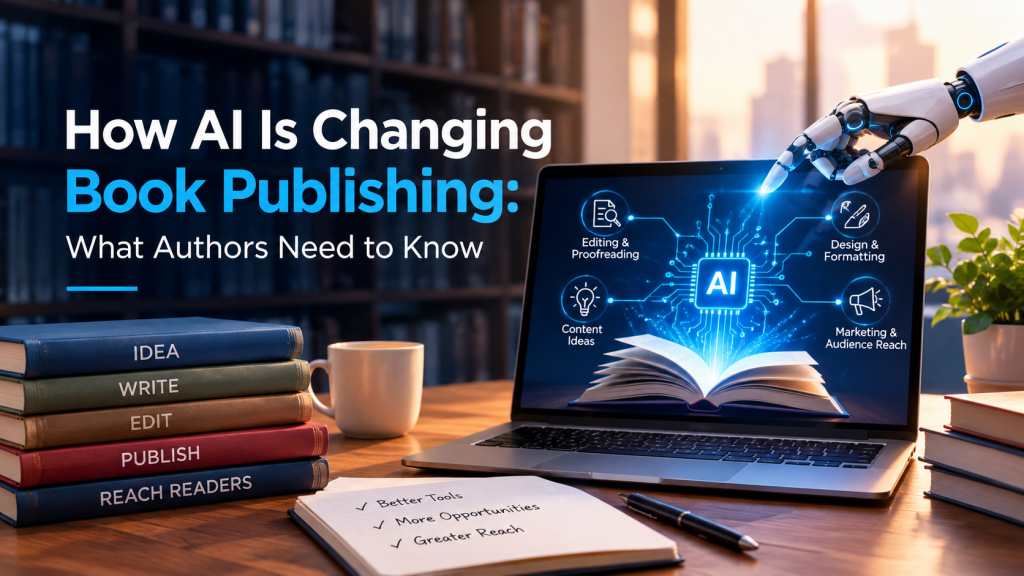
With advancements in technology, new self-publishers and authors are utilizing AI tools to democratize the publishing process. From ideation and drafting the initial version to editing and elevating the quality of the manuscript’s content, layout, design, and structure, the AI algorithm helps craft aesthetically pleasing book covers and generate impactful marketing campaigns. Self-publishers leverage digital technology such as Print-on-Demand (POD) services, and direct-to-reader platforms democratize book production, generating superb quality e-books and audiobooks. Hence, self-publishing an e-book lowers production costs and enables fast global distribution and sales of both print and digital manuscripts.
The Rise of E-Books in Modern Publishing
The emergence of e-books has spurred the book publishing business. Digital-format books have experienced exponential growth due to the widespread adoption of online retail. Major digital retailers and marketplaces such as Amazon KDP, Barnes & Noble Press, Kobo Writing Life, and Draft2Digital offer seamless conversion of files to various publishing formats. Moreover, they add metadata, set an appropriate price, and publish the manuscripts instantly. Modern publishing houses like Frontline Publishing are interconnected with online bookstores and distribution networks through Print-on-Demand services. E-books, audiobooks, and print versions are instantly produced via POD technology and distributed to a wider audience through direct integration with major retail platforms.
The publishers use digital platforms for quick, cost-effective distribution and sales. Independent bookstores, brick-and-mortar stores, and online retailers boost book sales. Initiating promotional discounts and other incentives increases book discoverability and helps sell e-books widely. The rise of e-book publishing has helped new publishers and authors to boost their visibility and marketability in the global book market. They tap into niche book publishing markets to pursue lucrative opportunities that are overlooked by traditional publishing houses.
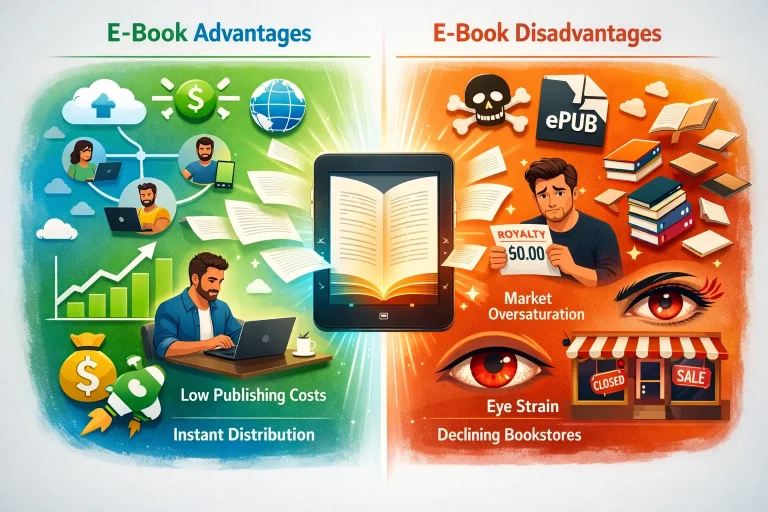
Indie authors managing a book publishing startup need to understand the advantages and disadvantages of e-books. The benefits of e-books include streamlining book production and accelerating the global reach.
Advantages of E-Books for Authors
Lower Publishing Costs
New authors seeking to publish their first manuscript look for an economical publishing option that reduces costs for editing, formatting, cover design, marketing, ISBN, and book distribution. It implies that independent publishers opt for self-publishing, which offers creative autonomy and the freedom to manage their publishing workflow. Self- publishing authors may hire a book publishing company to gain self-publishing services, including manuscript editing, cover design, formatting, and publishing services. Frontline Publishing Authors helps authors to reduce costs by offering free, user-friendly publishing tools for book editing, proofreading, cover design, layout, and formatting. Publishers also guide self-publishing authors in managing their book’s publication. They help indie authors to create a publishing account on self-publishing platforms such as Amazon KDP. These online publishing sites do not charge upfront fees to upload files, and a first-time author can conveniently convert the file to the required publishing format.
The author has the autonomy to create countless e-books in less time. Publishing digital books requires no physical storage or shipping costs, as e-books are formatted through online publishing tools and published via Print-on-Demand (POD) services that cater to clients’ needs. E-books are distributed to a vast audience through online publishing sites and global marketplaces. Thus, digital-format books are published promptly and accessible to a global audience, helping build readership and increase sales.
Flexible and Smooth Self-Publishing
Self-publishing authors bypassing traditional publishers find the convenience of managing the publishing process themselves. It includes exercising creative control over manuscript writing and editing. The designers develop stunning book covers with enhanced topography and add visual hierarchy. Moreover, publishers use digital publishing tools to convert files to formats such as PDF, EPUB, and MOBI. The e-book versions are published immediately and accessible to a broad audience within a few hours.
Global Distribution
To ensure prompt e-book distribution, self-published authors can use self-publishing platforms such as Amazon, Barnes & Noble, and IngramSpark for global distribution. These self-publishing outlets have worldwide networks of around 45,000 retailers and libraries, independent bookstores, and online retailers. Moreover, publishing houses like Frontline Publishing collaborate with self-publishing platforms for book distribution. The publishers use physical and online distribution networks to deliver audio, e-books, paperbacks, and hardcovers to a broad audience.
Premium Royalties
Independent authors also benefit from receiving a higher percentage of royalties. The Amazon KDP royalty structure for e-books follows the self-publishing model, with authors receiving a higher royalty rate of 35-70%. Whereas, for Amazon KDP Print, the authors receive a 60% share of the price after printing costs are decreased.
Faster Publishing and Distribution of E-books
If you are a new author, you may find self-publishing more flexible and hassle-free. No need to write query letters to find suitable literary agents who pitch your book to the publishers. Moreover, you may not wait for an extensive time to get your book published and reach the market. The process of self- publishing is simple and convenient; beginners need to have guidance on how to publish their manuscripts quickly. Once you have signed in to the publishing account on the Amazon KDP publishing site, you can format and upload the file to the Amazon KDP dashboard. A market-ready, well- structured and refined e-book is printed and accessible to the book market within 24–72 hours. Hence, new self-publishers find the self-publishing route more convenient and lucrative than other publishing options.
Advantages of E-Books for Publishers
Reduced Production Costs
If you are managing a self-publishing company, you may reduce your publishing and operational costs by shifting your publishing from print to e- book publishing. Digital format books eliminate physical production; the publishers no longer need to pay the material costs of paper, ink, and binding. Regarding warehouse storage and logistical management, self-publishers do not need to pay storage fees. As both print and e-books are manufactured through print-on-demand services, they are published according to the client’s requirements. Digital books are instantly published and delivered through online publishing sites or websites. Consequently, eliminating inventory and warehouse costs, logistic and freight charges, and ensuring wider distribution of books through online distribution networks, bookstores, retailers, and libraries.
Data and Analytics
Self-publishers can boost their e-book sales by tracking reader behavior and sales patterns. It implies that authors and publishers use specialized sales reporting and analytical tools, such as Book Report. The tool functions as a browser extension and turns complex KDP data into a user-friendly dashboard. The publishers can learn their sales performance in real time and also monitor royalty rates. Using the Scribe Count tool, the publishers get aggregate sales data from main retailers like Amazon, Kobo, Barnes & Noble, and Draft2Digital. The sales tracking tools help authors track page reads and completion rates, how many readers have opted for a Kindle Unlimited subscription, and other incentives. Additionally, they monitor their manuscript’s KDP category ranking, that increase organic traffic on the landing page and brings high conversion rates.
Faster Updates and Revisions
If the author intends to make some relevant changes in book cover designs, layout, or content after publishing, they have the convenience of revising the manuscript content. The authors upload the file and modify the content. It includes adding new chapters or illustrations to the book, and updated authors’ or publisher’s information. Moreover, the publishers also update metadata on Amazon KDP, such as adding new book descriptions, smart keywords, and appropriate prices. E-book modification takes 24–48 hours, and an updated book version reaches online stores and retailers within hours.
Disadvantages of eBooks for Authors
Encounter High Market Competition
Along with e-book benefits, new indie authors also face market challenges. Numerous books are published and reach bookstores by new and best-selling authors. So, it makes it difficult for new authors to establish their credibility in the competitive market and promote their publication extensively. As self-publishing authors manage every aspect of self-publishing themselves, they also perform self- marketing. It requires independent marketers to acquire technology and resources to boost marketing campaigns across digital platforms. Facing heavy marketing pressures, indie authors are unable to gain market visibility, and their manuscripts lack online presence. Consequently, it reduces book sales and profit.
Digital Piracy
Many self-publishing authors fail to get higher royalties and sales due to extreme online e-book piracy. Digital files are illegally copied and shared through torrent sites or file-hosting services. Unauthorized piracy groups, including websites and media, bypass copyright laws and DRM protection laws and get involved in illegitimate stealing of e-books, modifying book content and book covers without authors’ consent. Moreover, stolen digital books are sold at a low rate on platforms like Lazada, Shopee, and Amazon, or sold via monetized ads, and also distributed illegally. If a book is pirated, it loses originality and market value and does not attract retailers and bookstores. Therefore, self-published authors who are highly dependent on digital sales face financial loss due to fewer sales and limited royalties.
Substandard Consumer Perception and Value
Another disadvantage for authors is changing readers’ expectations, buying strategy, and physical, tangible presence. Many readers prefer reading print novels as they get attracted to premium quality paperbacks or hardcovers. Moreover, printed books offer tactile and sensory experiences that build emotional connection and bring an immersive reading experience. Hence, physical books have high physical presence and a higher perceived value than e-books.
Disadvantages of E-Books for Publishers
Price Pressure
Keeping an appropriate price strategy is a key challenge for self-publishers. If they keep the high prices of e-books, they might lose potential customers. Usually, readers expect low prices for published books. A tough market competition may compel the audience to purchase e-books from low-cost retailers that sell a broad category of digital format books at consistently low prices, while maintaining the book quality. Major retailers such as Amazon boost customer acquisition by adopting a low pricing strategy to drive e-book sales. Amazon’s reduced pricing strategy has compelled major publishing houses and small and independent bookstores and retailers to negotiate over regulating suitable e-book prices that resonate with potential audiences’ buying trends.
Platform Dependence
Another drawback of e-books is that the publishers rely on third-party platforms such as Amazon KDP, Apple, and Google for global book distribution. These online platforms charge an extensive amount of commissions, such as 30-70% of sales from publishers. It leads to fewer book sales and revenue.
Technology and Formatting Costs
New self-publishers who have shifted from print to digital production have to cover technology and formatting costs. Top- rated publishing houses like Frontline Publishing serve as key partners for self-publishers by managing the complex technical and formatting tasks. They also provide technical expertise and digital infrastructure to small publishers to perform technical editing, professional formatting, and convert manuscripts into different formats such as paperback, hardcover, ePub, MOBI, and XML. Moreover, they help publishers with multi-platform testing of e-books on Amazon Kindle, Apple Books, Kobo, and Google Play Books. The publishing team provides comprehensive support by creating high-quality, print-ready files that allow publishers to finalize the layout and prepare a commercially viable and polished manuscript.
The Future of eBooks in the Publishing Industry
Digital Publishing trends and innovations are fueled by AI-driven personalization, subscription models, interactive e-books, and AI-assisted publishing. The Frontline Publishing book publishers have produced numerous audiobooks based on different genres of books.
Audio Book Creation
High-quality professional audiobooks include AI narration with multi-voice performances, complete emotion and tone control, which improves storytelling. The audiobooks are accessible on major platforms such as Audible, Amazon, Spotify, and Apple Books, which increases book discoverability and brings high-margin revenue streams for authors and publishers.
Subscription Reading Platforms
Frontline Publishing Reviews suggests that readers should opt for Amazon’s Kindle Unlimited subscription service. The readers pay a monthly fee to avail unlimited access to read numerous genres of e-books. The subscription services help indie authors to expand their book reach and gain more subscribers. As readership increases, authors get higher royalties based on per page read.
Interactive E-Books
Prominent book publishing companies have significantly integrated AI technology to develop interactive e-books that offer a mesmerizing reading experience. Augmented reality (AR) display, 3D simulations, animated characters, and images in digital storybooks increase readers’ engagement.
AI-Assisted Publishing
Leading book publishers such as Frontline Publishing have integrated AI-algorithms to optimize publishing tasks. Content generation tools such as ChatGPT, and Jasper AI help in brainstorming and manuscript writing. AI -powered editing tools such as Grammarly and ProWritingAid enrich the content by improving syntax and grammar. Visual design tools such as Canva, Midjourney, and Ideogram design striking book covers and illustrations based on book genre. Moreover, the publishing house incorporates eco-friendly and sustainable publishing practices such as print-on-demand services that do not involve paper, ink, and carbon footprints in book production. The publishers use sustainable materials for printing, such as non-toxic or soy-based inks and water-based adhesives that reduce chemical pollution.
Recapitulate
E-book publishing has revolutionized the modern publishing landscape and benefited new self-published authors and publishers. To generate cost-effective digital format books, self-publishing authors bypass traditional gatekeepers and employ their creative freedom in managing book publishing workflow. The authors use self-publishing platforms such as Amazon Kindle (KDP) IngramSpark and Draft2Digital (D2D) for seamless formatting and publishing. These online publishing sites also facilitates in vast distribution of books. As self-publishing platforms work faster than traditional publishing, the digital format books reach the book market speedily. Consequently, the marketability and sales of e- books increases that benefit indie authors and publishers to boost their credibility and visibility in the market. The other benefits of e-book sales for indie authors are to gain higher royalty rates, around 35 percent to 70 percent, based on high sales volume.
Modern self- publishing houses have integrated AI technology to streamline the book publishing process. The production of audiobooks, interactive e-books, AI -assisted publishing, and eco-friendly and sustainable printing practices have helped in elevating e-book marketability across online platforms. The accessibility of e-books through online retailers and digital libraries allow audience to search new publications using online publishing sites. They can download the books for free to read or make online purchases. Hence, self- publishers have the opportunity to enter the global book market, establish their visibility, and empower global readers with providing premium quality digital content.