
1. Introduction
Have you ever had a book inside your head but no clear idea how to bring it into the real world? Maybe it’s a story you’ve been thinking about for years, knowledge you believe could help others, or simply a dream of seeing your name on a published book cover. But every time you try to start, you hit the same wall where do I begin, how does book publishing actually work, and what if I make a mistake and ruin everything? Because of this confusion, the idea often stays stuck, not due to a lack of talent, but because the process feels overwhelming and complicated. Most first-time writers don’t struggle with writing itself; they struggle with what comes next editing, formatting, cover design, uploading, pricing, and marketing all at once, which can feel like solving a puzzle without seeing the full picture.
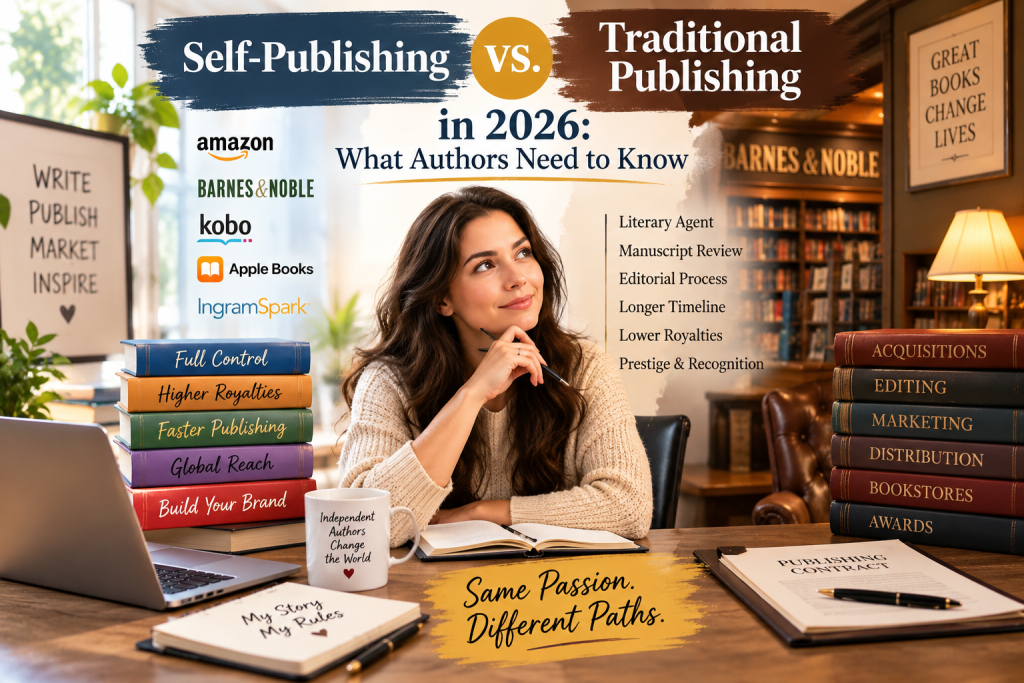
Yet the truth is that publishing a book today is no longer limited to big frontline publishing houses, as platforms like Amazon Kindle Direct Publishing allow anyone to turn a manuscript into a real published book available worldwide. Still, there is a big difference between simply publishing a book and publishing one that is professionally made and actually reaches readers. This is why some authors choose to do everything themselves, learning through trial and error, while others prefer a guided, professional approach to avoid mistakes and save time. This guide is designed to remove that confusion and give you a clear, simple path from idea to published book.
2. What Is Amazon Self-Publishing?
Amazon self-publishing refers to a system where authors can publish their books directly on Amazon without going through traditional publishing companies.
This system works through a platform called Kindle Direct Publishing (KDP).
With Amazon KDP, you can publish:
- eBooks (digital books for Kindle devices and apps)
- Paperbacks (printed physical books)
- Hardcovers (available in selected regions)
The process is designed to be accessible to anyone, even beginners.
One of the biggest advantages of Amazon self-publishing is that it removes traditional barriers. You don’t need:
- A literary agent
- A publishing contract
- A large upfront investment
You simply upload your manuscript, design your book details, and publish.
Why Amazon KDP Is So Popular
There are several reasons why millions of authors choose Amazon:
1. Full Ownership
You maintain complete rights over your book. You are the publisher.
2. High Royalty Rates
Authors can earn up to 70% royalties depending on pricing and region.
3. Global Distribution
Your book becomes available to readers across multiple countries instantly.
4. Fast Publishing Speed
Unlike traditional publishing, your book can go live in 24–72 hours.
However, while the platform is simple, success is not automatic.
Many books are published every day—but only a small percentage get noticed. This is where strategy, quality, and marketing become important.
That is why many authors choose professional support to help with book editing, formatting, design, and marketing.
3. Step 1: Write and Prepare Your Manuscript
Every book begins with one essential foundation: the manuscript.
This is where your idea transforms into something structured and readable.
The Writing Journey
Writing a book is not a single action—it is a process:
1. Drafting Stage
This is where you write freely. Don’t worry about grammar or perfection. Focus on getting your ideas out.
2. Revision Stage
Here you improve structure. You may rearrange chapters, refine arguments, or improve storytelling flow.
3. Final Draft Stage
This is the polished version of your book, ready for editing and formatting.
Many first-time authors get stuck because they try to make everything perfect from the beginning. This slows progress.
A better approach is to finish first, improve later.
Common Mistakes New Writers Make
Most beginners struggle with similar issues:
- Overthinking every sentence
- Starting multiple drafts but never finishing
- Ignoring structure and flow
- Not seeking feedback
These habits delay completion and reduce confidence.
The Importance of Editing
Editing is one of the most critical steps in publishing.
A well-edited book:
- Feels professional
- Reads smoothly
- Builds trust with readers
Even great ideas can fail if poorly edited.
Professional editing improves grammar, clarity, tone, and readability. It ensures your message is communicated effectively.
Think of writing as building a house and editing as finishing the interior. The structure is there, but refinement makes it livable and appealing.
4. Step 2: Professional Formatting and Structure
Once your manuscript is complete, it must be properly formatted before publishing.
Formatting is often underestimated but it directly affects how readers experience your book.
What Is Book Formatting?
Formatting involves:
- Font style and size
- Paragraph spacing
- Chapter alignment
- Margin setup
- Page numbering
A poorly formatted book can look unprofessional even if the content is excellent.
Kindle vs Print Formatting
There are two main formats:
1. eBook Formatting (Kindle)
- Designed for digital reading
- Adjusts automatically to screen size
- Requires clean structure and clickable navigation
2. Print Formatting (Paperback/Hardcover)
- Fixed layout
- Requires precise margin control
- Must meet printing standards
Each format has different technical requirements.
Why Formatting Matters So Much
Readers judge professionalism instantly. If your book looks messy or inconsistent, it affects trust and readability.
Good formatting ensures:
- Smooth reading experience
- Professional appearance
- Higher reader satisfaction
This is why many authors choose professionals to handle formatting correctly from the start.
5. Step 3: Design a High-Converting Book Cover
Your book cover is your first impression and often your most powerful book marketing tool.
In a digital marketplace like Amazon, readers scroll through hundreds of options. Your cover determines whether they stop or ignore your book.
Why Book Covers Matter
A strong cover:
- Attracts attention instantly
- Communicates genre clearly
- Influences purchase decisions
- Increases click-through rates
Elements of a Great Cover
An effective cover includes:
- A clear title
- Strong typography
- Balanced color scheme
- Genre-appropriate design
- Emotional or visual appeal
Genre-Based Design Strategy
Different genres require different visual styles:
- Romance → soft tones, emotional imagery
- Thriller → dark, high-contrast visuals
- Business → clean, minimal, professional
- Fantasy → artistic, imaginative elements
A mismatch between cover and genre confuses readers and reduces sales.
The Power of Professional Design
Professionally designed covers often perform significantly better because they follow marketing principles, not just aesthetics.
A strong cover can increase visibility and even double conversion rates in some cases.
6. Step 4: Upload Your Book on Amazon KDP
Once your manuscript, formatting, and cover are ready, you move to the publishing stage.
Uploading your book to Amazon KDP involves entering key information.
Required Details
You will need:
- Book title
- Subtitle
- Author name
- Book description
- Categories
- Keywords
Each element plays a role in discoverability.
The Importance of Keywords
Keywords help Amazon understand what your book is about.
Good keywords:
- Improve search ranking
- Increase visibility
- Target the right audience
You are allowed to add multiple backend keywords to optimize discovery.
Writing a Strong Book Description
Your book description is your sales pitch.
A good description:
- Hooks the reader in the first lines
- Explains the value of the book
- Creates emotional or intellectual interest
- Encourages purchase
Think of it as advertising your story in a few paragraphs.
7. Step 5: Set Pricing and Royalties
Pricing is both an art and a strategy.
Amazon Royalty Options
Amazon offers two main royalty models:
- 35% royalty option
- 70% royalty option (with conditions)
How to Price Your Book
Pricing depends on:
- Genre
- Length
- Market competition
- Author reputation
Smart Pricing Strategy
Many new authors:
- Start with lower prices
- Build reviews and visibility
- Increase price gradually
This strategy helps attract early readers and build credibility.
8. Step 6: Publish Your Book
After everything is set, you are ready to publish.
Before clicking “Publish,” always:
- Review all details carefully
- Check formatting using preview tools
- Ensure cover alignment is correct
Once published, your book usually becomes live within 24–72 hours.
This is the moment every author remembers it marks the transition from writer to published author.
9. Step 7: Book Marketing (Most Important Step)
Publishing is not the final goal visibility is.
Without marketing, even great books remain undiscovered.
Why Books Fail
Most books fail due to:
- No promotion strategy
- Weak keyword usage
- Lack of audience targeting
- No reviews
Effective Marketing Strategies
1. Amazon SEO
Use relevant keywords to improve search ranking.
2. Social Media Marketing
Platforms like Instagram, Facebook, and TikTok help build audience awareness.
3. Amazon Ads
Paid ads increase visibility and reach targeted readers.
4. Reviews Strategy
Early reviews build trust and influence buying decisions.
Marketing is not optional it is essential.
Think of publishing as planting a seed, and marketing as watering it. Without water, nothing grows.
10. DIY vs Professional Services
There are two main approaches:
DIY Publishing
- Full control
- Lower cost
- Steeper learning curve
- Time-intensive
Professional Services
- Done for you system
- Expert support
- Faster results
- Higher quality output
DIY works well for learners, while professional services are ideal for authors who want efficiency and polished results.
11. Common Mistakes to Avoid
Avoid these mistakes if you want success:
- Skipping editing
- Poor cover design
- Weak keyword strategy
- Ignoring marketing
- Rushing publication
Each of these can significantly reduce your book’s performance.
12. Complete Self-Publishing Checklist
Before publishing, ensure:
- Manuscript is complete
- Editing is done
- Formatting is professional
- Cover is high quality
- Keywords are optimized
- Marketing plan is ready
Missing even one step can affect your results.
13. Why Choose Professional Help?
Publishing a book is easier today but success still requires skill.
Professional services offer:
- Time efficiency
- Higher publishing quality
- Better marketing strategy
- Reduced mistakes
Many authors choose this route to focus on writing while experts handle technical and marketing tasks.
14. Conclusion
Publishing a book is one of the most rewarding achievements a writer can experience. You now understand the full process from writing your manuscript and editing it, to formatting, designing your cover, publishing on Amazon, and finally marketing your book. While the journey may seem complex at first, it becomes much more manageable when broken down into clear, simple steps that guide you from idea to finished product.
The real difference between aspiring writers and published authors is simple: action. You can continue planning, overthinking, and delaying or you can start building your author journey today. Your story has value, and it deserves to be shared with the world. The only question that remains is whether the world will get the chance to read it.