Publishing a book is one of the most exciting milestones in an author’s journey. Yet, many aspiring writers never take that first step because they’ve heard advice that simply isn’t true. From social media posts to outdated articles and even well-meaning friends, publishing myths continue to spread and discourage talented authors from sharing their work with the world.
The publishing industry has changed dramatically over the past decade. Today, authors have more choices than ever before. Whether you dream of working with a traditional publisher, choosing self-publishing, or exploring a hybrid publishing model, there is no single path that guarantees success. What matters most is understanding your options and making decisions based on facts instead of misconceptions.
Unfortunately, many first-time authors still believe they must land a literary agent before they can publish, that self-published books look unprofessional, or that simply releasing a book will automatically lead to thousands of sales. These myths can cost authors valuable time, money, and confidence.
If you’ve been researching publishers, reading Frontline Publishing Reviews alongside independent industry resources can help you better understand the experiences of different authors and the publishing support available today. Learning from real experiences often provides a clearer picture than relying on outdated assumptions alone.
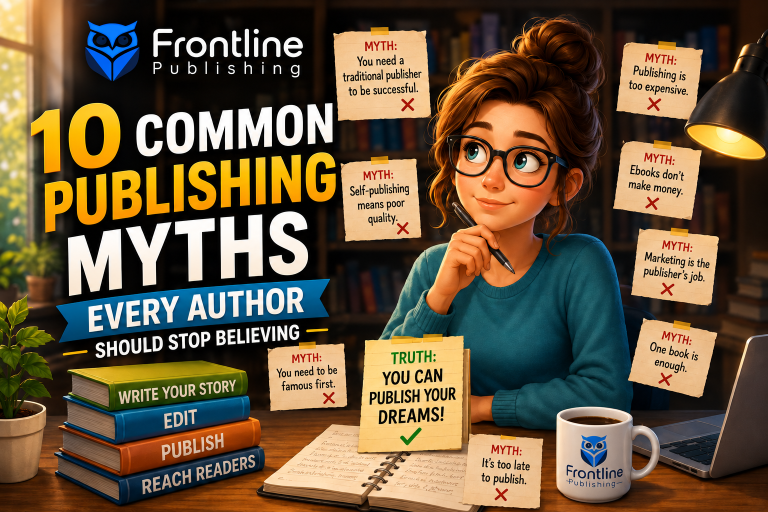
In this guide, we’ll debunk ten of the most common publishing myths that continue to confuse writers. You’ll learn how today’s publishing industry really works, why these misconceptions still exist, and how to make smarter decisions that support your long-term success as an author.
Whether you’re writing your first novel, a business book, a memoir, or a children’s story, understanding the truth behind these myths will help you move forward with greater confidence.
Why Publishing Myths Continue to Mislead New Authors
How Outdated Advice Still Circulates
Publishing has evolved quickly, but much of the advice shared online hasn’t.
Years ago, traditional publishing was considered the only realistic option for most writers. Self-publishing trends were limited, print quality varied, and authors had fewer ways to market their books independently. As a result, many of the “rules” from that era are still repeated today, even though the industry has changed significantly.
Unfortunately, outdated blog posts, forum discussions, and word-of-mouth advice continue to shape how new authors think about publishing. Someone who published a book ten years ago may have had a completely different experience than an author publishing today.
That’s why it’s important to verify information using current, reliable sources instead of relying on old assumptions.
The Influence of Social Media Opinions
Social media has made it easier than ever for authors to share their experiences. While that can be helpful, it’s important to remember that one person’s publishing journey doesn’t represent everyone else’s.
For example, one writer may achieve success through traditional publishing, while another builds a thriving career through self-publishing. Both stories are valid, but neither proves that one publishing path is the only correct choice.
Instead of following every opinion you read online, look for balanced information backed by real publishing experience and industry knowledge.
Every Author’s Journey Is Different
No two authors have the same goals.
Some writers want complete creative control over their books. Others prefer working closely with a publishing team. Some hope to build a personal brand, while others simply want to share their stories with family, friends, or a niche audience.
The best publishing decision depends on your objectives, budget, timeline, and willingness to participate in marketing.
Taking time to understand your own goals will help you choose the publishing path that fits your needs instead of following someone else’s expectations.
Key Takeaways
- Publishing has changed dramatically over the last decade.
- Advice that worked years ago may no longer apply today.
- Every author’s goals and publishing journey are unique.
- Researching current publishing practices helps reduce costly mistakes.
Myth #1 — Traditional Publishing Is the Only Path to Success
Perhaps the biggest myth in the publishing world is that success only comes through a traditional publishing contract.
Many aspiring writers believe they must first secure a literary agent, receive acceptance from a major publishing house, and wait months or even years for their book to reach readers. While this route works well for some authors, it is far from the only path available.
Today’s publishing landscape offers several legitimate options, including independent publishing and hybrid publishing. Each model has its own advantages, and the right choice depends on your personal goals rather than outdated industry expectations.
Digital publishing has also created opportunities that simply didn’t exist years ago. Authors can now publish eBooks, print-on-demand editions, audiobooks, and global digital releases without waiting for approval from a large publishing house.
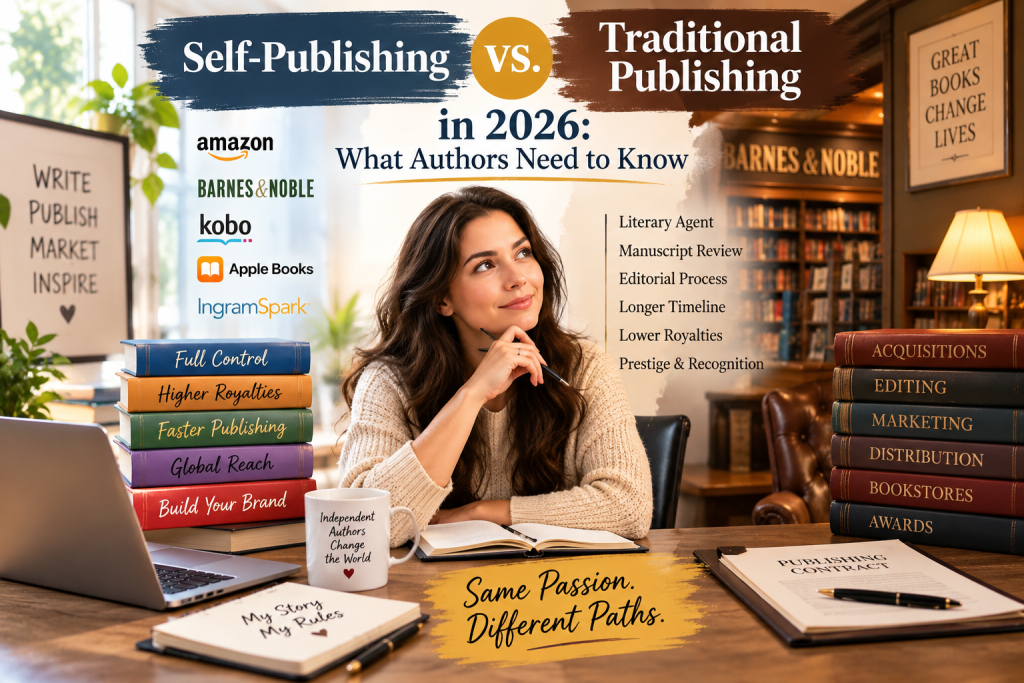
Understanding the modern publishing journey can help authors compare traditional, hybrid, and self-publishing options before making a decision.Many successful independent authors have built loyal audiences, earned strong royalties, and established long-term careers by combining high-quality books with consistent marketing efforts.
The key is not choosing the “most prestigious” publishing model, it’s choosing the one that aligns with your goals.
Traditional Publishing vs. Self-Publishing vs. Hybrid Publishing
| Feature | Traditional Publishing | Self-Publishing | Hybrid Publishing |
| Creative Control | Limited | Full | Shared |
| Publishing Speed | Slow | Fast | Moderate |
| Upfront Investment | Usually Low | Varies | Varies |
| Royalty Percentage | Lower | Higher | Depends on Agreement |
| Marketing Support | Limited | Author-Led | Shared Responsibility |
Each publishing path offers different benefits. Understanding these differences helps you make an informed decision instead of following outdated advice.
Myth #2 — Self-Published Books Aren’t Professional
This myth may have been true many years ago, but it no longer reflects today’s publishing industry.
Modern self-published books often feature professional editing, eye-catching cover designs, polished formatting, and excellent print quality. In many cases, readers can’t tell whether a book was traditionally published or independently published simply by looking at it.
The difference usually comes down to preparation.
Authors who invest in editing, proofreading, professional cover design, and proper formatting create books that meet the same quality standards readers expect from established publishers.
Print-on-demand technology has also improved significantly, allowing independent authors to produce books that look and feel professional.
A reputable Book Publishing Company or experienced publishing partner can also help authors navigate important steps such as ISBN registration, formatting, distribution, and quality control while allowing them to maintain greater involvement in the publishing process.
Many authors now benefit from innovative publishing solutions that provide professional editing, design, and distribution services.
Myth #3 — Publishing a Book Guarantees Instant Sales
Many first-time authors imagine that once their book goes live, readers will automatically discover it and sales will begin immediately.
In reality, publishing is only the beginning.
A successful book usually requires ongoing promotion. Authors who consistently market their work often see better long-term results than those who simply publish and wait.
Effective marketing can include:
- Building an author website
- Optimizing book descriptions and keywords
- Encouraging honest reader reviews
- Sharing content on social media
- Appearing on podcasts
- Sending email newsletters
- Reaching out to local media
- Participating in book events and author communities
Think of your book as a new business. Even the best product needs visibility before people can buy it.
Many authors who receive positive Frontline Publishing Author Reviews or other reader feedback discover that reviews alone aren’t enough. Continued marketing and audience engagement remain essential for building lasting momentum.
Successful authors understand that digital publishing platform opens the door but consistent marketing helps readers find what’s waiting on the other side.
Myth #4 — You Need a Large Following Before Publishing
One of the biggest fears among first time authors is believing they need thousands of followers before publishing a book. This myth often causes writers to delay their dream for months or even years.
The truth is that many author success stories started with a very small audience or no audience at all.
Your readers don’t have to know who you are before you publish. Instead, publishing can be the beginning of building your audience.
Think about it this way. A book gives people something to discover, recommend, and talk about. Without a published book, it’s much harder to grow your reputation as an author.
Build Your Audience Step by Step
You don’t need to become a social media influencer overnight. Focus on creating genuine connections with readers through simple but consistent efforts.
Here are a few effective ways to grow your audience:
- Create an author website.
- Start an email newsletter.
- Share helpful content on social media.
- Join online book communities.
- Appear on podcasts related to your niche.
- Attend local author events and book fairs.
- Encourage readers to leave honest reviews.
Many authors begin with just a handful of readers and gradually build a loyal community over time.
Remember, readers connect with authenticity more than follower counts.
Myth #5 — Good Books Sell Themselves
We’ve all heard the phrase, “If the book is good enough, people will find it.”
Unfortunately, that’s rarely how publishing works today.
Writing a great book is incredibly important, but quality alone doesn’t guarantee visibility. Every year, millions of new books are published across different genres. Without marketing, even an outstanding book can remain unnoticed.
Imagine opening a beautiful bookstore with no signs, advertisements, or directions. Even if you have amazing books inside, very few people will know where to find them.
The same applies to publishing.
Marketing Is Just as Important as Writing
Successful authors understand that marketing is part of the publishing journey.
Some effective marketing strategies include:
- Optimizing your Amazon listing.
- Choosing the right book categories.
- Researching relevant keywords.
- Writing a compelling book description.
- Building an author website.
- Creating a book trailer.
- Sending press releases.
- Encouraging reader reviews.
- Sharing valuable content on social media.
Marketing isn’t about constantly selling. It’s about helping the right readers discover your book.
If readers never hear about your work, they can’t buy it no matter how well it’s written.
Myth #6 — Authors Must Do Everything Alone
Some writers believe they have to wear every hat during the publishing process.
They try to edit their manuscript, design the cover, format the interior, create marketing materials, build a website, manage advertising, and handle distribution entirely on their own.
While it’s certainly possible to learn these skills, doing everything yourself often leads to unnecessary stress and lower quality results.
Publishing is a team effort.
Professional authors regularly work with editors, designers, illustrators, proofreaders, marketers, and publishing consultants.
Each expert brings valuable experience that improves the final product.
The Value of Professional Support
Depending on your goals, you may choose to work with professionals who specialize in:
- Developmental editing
- Copy editing
- Proofreading
- Cover design
- Interior formatting
- Illustration
- Book marketing
- Website development
- Distribution support
Choosing experienced Professional Book Publishing Services can save time, improve quality, and help you avoid common publishing mistakes.
Collaboration doesn’t reduce your creative control, it strengthens your book and empowering authors.
Think of it like building a house. Even if you understand construction, hiring specialists often leads to a stronger final result.
Myth #7 — Publishing Is Too Expensive
Many aspiring authors assume publishing always costs tens of thousands of dollars.
In reality, publishing costs vary depending on your goals, your experience, and the level of professional support you choose.
Some authors publish independently using free tools and invest only in editing and cover design. Others choose comprehensive publishing packages that include editing, formatting, distribution, and marketing.
Neither approach is automatically better.
The important question is where your investment creates the greatest value.
Common Publishing Expenses
Typical publishing costs may include:
- Professional editing
- Cover design
- Interior formatting
- ISBN registration
- Printing
- Marketing
- Website creation
- Advertising
Rather than asking, “How can I spend the least?”
Ask,
“Which investments will make my book more successful?”
A trusted Book Publishing Company can often help authors understand these costs and recommend services that match their publishing goals and budget.
Publishing should be viewed as an investment in your work rather than simply an expense.
Myth #8 — Once Published, the Work Is Finished
Many authors celebrate publication day believing the hard work is finally over.
In reality, publication day is the beginning of a new chapter.
The most successful authors continue promoting their books long after launch.
They build relationships with readers.
They update their websites.
They speak at events.
They appear on podcasts.
They write guest articles.
They release audiobooks.
They publish revised editions.
They continue growing their author brand.
Think Long-Term
Books often gain momentum over months or even years.
Some titles don’t become popular until well after their initial release.
Consistent promotion keeps your book visible to new readers.
Many authors who share positive Frontline Publishing Author Reviews also emphasize that long-term marketing played a significant role in their publishing success stories. Building a readership takes time, patience, and ongoing effort.
Your first book isn’t the finish line.
It’s the foundation for your future career as an author.
Myth #9 — Reviews Don’t Matter
Some new authors believe reviews are simply nice to have. Others think only bestseller books need reviews. In reality, reviews play a much bigger role than many people realize.
Reviews build trust.
When readers discover a new book, one of the first things they check is what other readers have to say. Honest author reviews help potential buyers decide whether a book is worth their time and money.
Reviews also improve visibility on many online bookstores. While no one can guarantee how any platform ranks books, positive reader engagement often encourages more people to explore your title.
Why Reviews Are Important
Reviews can help you:
- Build credibility with new readers.
- Increase reader confidence before purchasing.
- Encourage word-of-mouth recommendations.
- Strengthen your online author reputation.
- Provide valuable feedback for future books.
Beyond online bookstores, reviews can also influence bloggers, podcast hosts, journalists, and librarians who are looking for books to recommend.
How to Earn Reviews the Right Way
Always focus on earning genuine, honest feedback rather than asking for only positive reviews.
Some ethical ways to receive reviews include:
- Asking readers at the end of your book.
- Building an email list of engaged readers.
- Sending advance review copies to reviewers.
- Working with book bloggers.
- Participating in author communities.
- Following up politely after a purchase.
Remember, authenticity matters. Honest reviews carry far more value than artificially boosting ratings.
Myth #10 — Every Publishing Company Is the Same
One of the most costly assumptions an author can make is believing every publisher offers the same level of service.
The truth is that publishing companies vary widely in their experience, communication, transparency, and support.
Some companies focus only on getting your book published.
Others provide guidance before, during, and after publication to help authors build long-term success.
When researching a publisher, don’t look only at pricing. Consider the overall value and the services included.
What to Look for in a Publishing Partner
Ask questions about:
- Editorial quality
- Cover design
- Interior formatting
- Distribution channels
- Marketing support
- Royalty reporting
- Contract transparency
- Customer communication
- Author education
- Long-term support
Reading independent Frontline Publishing Author Reviews can help you compare real experiences before choosing a publishing partner.
A trustworthy publishing partner should be willing to answer your questions openly and explain every step of the publishing process.
How to Evaluate Publishing Advice Before Believing It
The internet is filled with publishing advice, but not all of it is accurate or current.
Before following any recommendation, pause and ask yourself a few simple questions.
Is the Advice Current?
Publishing changes quickly.
Advice from five or ten years ago may no longer apply today.
Does It Match My Goals?
Every author has different priorities.
Some value creative control.
Others want wider distribution.
Choose advice that aligns with your own publishing goals.
Is the Source Experienced?
Look for information from experienced publishing professionals, established organizations, and authors who have successfully published books.
Can It Be Verified?
Whenever possible, compare information across multiple trusted sources rather than relying on one opinion.
Does It Reflect Today’s Publishing Industry?
Technology, reader behavior, and publishing models continue to evolve.
Good advice reflects today’s marketplace—not yesterday’s.
Questions Every Author Should Ask Before Publishing
Before choosing a publishing path, take time to answer these important questions.
What Are My Publishing Goals?
Are you publishing to build a business?
Share your story?
Generate income?
Increase professional credibility?
Your goals will influence every decision that follows.
Who Is My Target Audience?
Knowing your readers helps shape your writing, marketing, and promotional strategy.
How Much Marketing Am I Willing to Do?
Every book benefits from marketing.
Decide early how involved you want to be after publication.
Do I Want Creative Control?
Some authors prefer making every decision themselves.
Others appreciate collaborating with publishing professionals.
What Is My Budget?
Understanding your budget helps you prioritize services that offer the greatest value.
What Timeline Am I Expecting?
Some publishing methods move much faster than others.
Knowing your desired timeline can help narrow your options.
Practical Tips for Making Smarter Publishing Decisions
Publishing success doesn’t happen by accident.
It comes from thoughtful planning, continuous learning, and making informed choices.
Here are a few practical tips to help you move forward with confidence.
Research Publishers Carefully
Don’t choose the first publisher you find.
Compare services, contracts, communication, and author experiences.
Compare Different Publishing Models
Understand the differences between traditional publishing, self-publishing, and hybrid publishing before making a decision.
Invest in Professional Editing
Even experienced writers benefit from professional editing.
Fresh eyes can identify issues that authors often overlook.
Build Your Author Platform
Create a professional website.
Start an email newsletter.
Connect with readers consistently.
Learn Basic Book Marketing
You don’t need to become a marketing expert overnight.
Learning simple promotional strategies can make a significant difference.
Think Long-Term
Publishing one successful book is great.
Building a lasting author career is even better.
Learn from Other Authors
Reading Frontline Publishing Author Reviews and other genuine author experiences can provide practical insights into the publishing process, helping you understand what to expect and how to prepare for your own journey.
Final Thoughts
Publishing is filled with opportunities, but it’s also surrounded by myths that can discourage talented writers from sharing their stories.
The good news is that today’s authors have more choices than ever before.
Whether you choose traditional publishing, self-publishing, or work with a trusted publishing partner, success comes from making informed decisions based on facts—not outdated assumptions.
Take time to research your options.
Ask questions.
Learn from experienced professionals.
Most importantly, don’t let common publishing myths stop you from achieving your dream of becoming a published author.
Every successful author started exactly where you are now—with an idea, a manuscript, and the courage to take the next step.
Frequently Asked Questions (FAQs)
Is traditional publishing better than self-publishing?
Neither option is universally better. Traditional publishing offers established industry support, while self-publishing provides greater creative control and often higher royalty potential. The best choice depends on your goals.
Can self-published books become bestsellers?
Yes. Many independently published books have achieved commercial success through professional production, effective marketing, and strong reader engagement.
Do authors need a literary agent?
Not always. While literary agents are often helpful for traditional publishing, authors pursuing self-publishing or hybrid publishing may not need one.
How much does it cost to publish a book?
Publishing costs vary depending on editing, design, formatting, printing, and marketing services. Your budget should reflect your publishing goals and the level of professional support you want.
Can I publish without an audience?
Absolutely. Many successful authors begin with little or no audience and grow their readership over time through consistent marketing and engagement.
Are publishing companies worth hiring?
For many authors, yes. Experienced publishers can provide guidance, professional production, and publishing expertise that improve the overall quality of a book.
How long does publishing usually take?
Publishing timelines vary. Self-publishing can often be completed within a few months, while traditional publishing may take a year or longer.
How important is book marketing?
Marketing is essential. Even excellent books benefit from ongoing promotion to help readers discover them.
What should first-time authors avoid?
Avoid rushing the publishing process, skipping professional editing, ignoring marketing, and believing common publishing myths without researching current information.
How do I choose the right publishing partner?
Compare services, communication, transparency, contracts, distribution options, and genuine author feedback before making your decision.