Artificial intelligence has quickly become part of the modern publishing conversation. Authors are using AI to brainstorm ideas, organize research, check grammar, develop marketing concepts, and explore different ways to present their books.
But AI also creates new questions. Who owns AI-generated content? Should authors tell readers when AI was used? What does Amazon KDP require? Is it safe to upload an unpublished manuscript into an AI tool? And where should human editors, designers, and publishing professionals remain involved?
These aren’t small questions.
The good news is that authors don’t have to choose between technology and human creativity. AI can be useful when it’s treated as a tool rather than a replacement for the author.
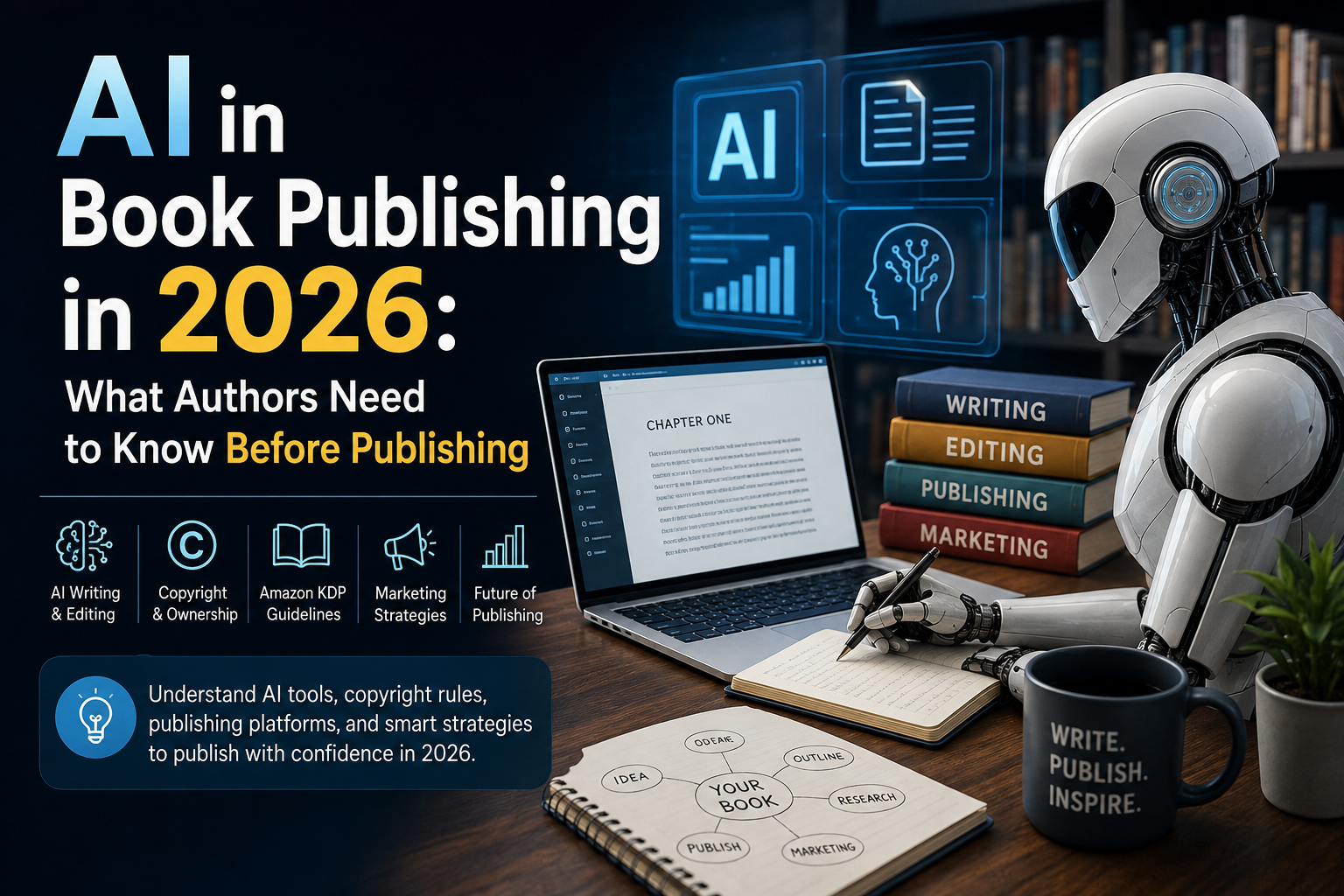
This guide explains what authors should understand before publishing a book with AI involved in the process.
How AI Is Changing Book Publishing in 2026
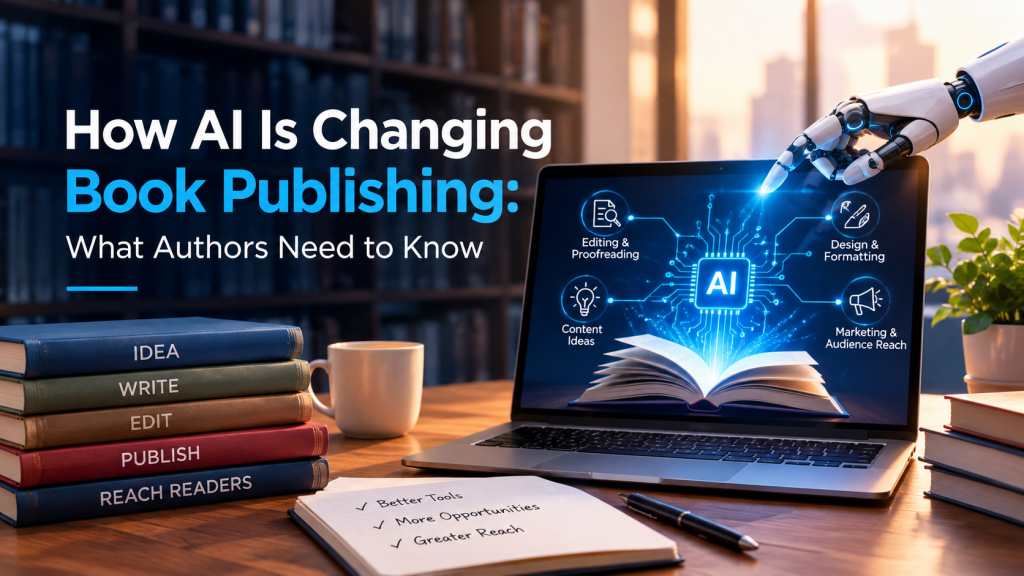
AI is now being used across many parts of the publishing workflow.
An author might use it to brainstorm chapter ideas, organize notes, identify repetitive wording, create a content calendar, or develop questions for an interview. Publishers and publishing professionals may also use technology for selected administrative and production tasks.
The important point is that not every use of AI is the same.
There is a major difference between asking an AI tool to suggest ten possible chapter titles and asking it to write an entire chapter that you publish as your own.
That difference matters for platform policies, copyright, contracts, privacy, and reader expectations.
The U.S. Copyright Office has specifically examined copyrightability of generative-AI outputs. Its current position is that AI-assisted creation can still result in copyrightable work when there is sufficient human creative contribution, while merely providing prompts does not by itself establish authorship.
For authors, the practical lesson is simple: keep yourself at the center of the creative process.
AI-Assisted vs. AI-Generated Content: What’s the Difference?
One of the most important things to understand before publication is the difference between AI-assisted and AI-generated material.
What Is AI-Assisted Content?
Imagine you’ve written a chapter yourself. You then use an AI tool to find spelling mistakes, point out repeated phrases, or suggest ways to make a sentence easier to read.
That’s an example of AI assistance.
Other examples include:
- Brainstorming book ideas
- Creating an outline
- Organizing research notes
- Checking grammar
- Finding repetitive wording
- Suggesting headlines
- Developing marketing ideas
- Creating a list of questions for research
Amazon KDP currently distinguishes this type of use from AI-generated content. If the author creates the underlying content and uses AI to edit, refine, error-check, or brainstorm, Amazon classifies that as AI-assisted content.
What Is AI-Generated Content?
AI-generated content is different.
For example, if an AI tool creates the actual chapter, illustration, or translation that becomes part of your published book, Amazon currently considers that AI-generated content.
KDP currently requires authors to inform Amazon when publishing books containing AI-generated text, images, or translations. This includes AI-generated cover and interior artwork.
This distinction is worth understanding before you upload your book.
Can Authors Use AI to Write a Book?
Yes, authors can use AI during the writing process, but the way they use it matters.
AI can help you explore a story idea. It can suggest possible characters, themes, chapter structures, or questions to investigate.
For nonfiction, it can help organize a large collection of notes.
For fiction, it can help you think through possible plot directions.
But there’s a major difference between using AI to support your thinking and allowing AI to make most of the creative decisions.
Your experiences, opinions, voice, characters, memories, and creative choices are what make your book yours.
Think about it like working with a writing assistant. A good assistant can give you options. You still decide which direction the book takes.
That approach also gives you greater control over the final quality.
AI and Copyright: What Authors Should Know
Copyright is one of the most complicated parts of the AI discussion.
The U.S. Copyright Office’s January 2025 report explains that copyrightability depends on the human contribution involved. Human-authored material can remain protected when AI is used as part of the creative process, and human creative arrangements or modifications of AI output can matter. Simply entering prompts, however, is not enough by itself.
This means authors should avoid assuming:
“I typed the prompt, so I automatically own the copyright.”
It’s not that simple.
Keep Your Creative Records
If you’re using AI during your publishing process, keep your original work and development records.
These might include:
- Original manuscript drafts
- Revision history
- Research notes
- Human-written passages
- Design files
- Contracts
- Licensing documents
- Notes about how AI was used
These records can help you understand and document your creative process.
They aren’t a guarantee of copyright protection. But maintaining a clear record is a sensible publishing practice.
Copyright rules can also change, so authors dealing with complex ownership questions should consider getting advice from a qualified copyright professional.
Should Authors Tell Readers They Used AI?
There isn’t one answer for every situation.
It depends on how AI was used, what platform you’re publishing through, what your contract says, and what disclosure rules apply.
For example, Amazon currently requires disclosure of AI-generated text, images, and translations submitted through KDP, while AI-assisted content doesn’t require the same disclosure under its current guidelines.
Contracts can also matter.
The Authors Guild’s current AI-related model clauses address issues such as AI training, audiobook narration, translation, artwork, author use of AI, and publisher use of AI.
So before publishing, don’t simply ask:
“Do I have to disclose AI?”
Ask:
“How did I use AI, what rules apply to my book, and what does my publishing agreement require?”
AI and Amazon KDP in 2026
Amazon KDP is especially important for independent authors.
Under KDP’s current guidelines, authors must inform Amazon about AI-generated text, images, or translations. AI-assisted content does not require disclosure under the current policy.
AI-Generated Text
If an AI tool creates the actual text that appears in your book, Amazon currently considers it AI-generated, even if you later make substantial edits.
AI-Generated Images
This can include:
- Book covers
- Interior illustrations
- Children’s book artwork
- Other images included in the book
AI-Generated Translations
If AI creates the translation used in the published book, that also falls under Amazon’s current AI-generated content disclosure requirement.
Why Authors Should Check the Rules
Publishing platforms update their policies.
What is permitted or required today may change later.
Before uploading a book, always check the current KDP guidelines rather than relying on an old blog post or social-media discussion.
Using AI for Book Editing and Proofreading
AI can be useful during an early editing pass.
It can help identify:
- Spelling errors
- Basic grammar problems
- Repeated words
- Awkward sentences
- Simple consistency issues
- Readability problems
But editing a book involves much more than correcting sentences.
A developmental editor may identify a weak storyline, confusing structure, an underdeveloped character, or a section that doesn’t serve the reader.
An AI tool may flag a sentence. It doesn’t automatically understand why that sentence matters to the story.
A practical workflow can look like this:
Author → AI-assisted check → professional editor → author revision → proofreader → final manuscript
That combination keeps technology useful while preserving human judgment.
AI and Professional Ghostwriting
AI has also changed conversations around professional ghostwriting services.
A ghostwriter may use technology for brainstorming or organization, but the most important part of ghostwriting remains understanding the author’s voice and goals.
A memoir, for example, isn’t simply a collection of correctly written sentences. It contains memories, emotions, experiences, and personal meaning.
The same applies to business books, biographies, fiction, and self-help books.
If you’re considering professional ghostwriting services, ask how technology is used during the process.
You may want to know:
- Is AI used for drafting?
- Is my manuscript uploaded to third-party AI systems?
- Who owns the final work?
- How is my information protected?
- Who performs the final editorial review?
- What happens to my manuscript after the project ends?
These questions are becoming more important.
The Authors Guild has specifically warned about publishers and publishing professionals uploading manuscripts or personal information to consumer AI systems without author permission or adequate safeguards.
AI Book Cover Design and Illustration
AI can be useful during the visual planning stage.
For example, an author might use it to explore:
- Color combinations
- Mood
- Visual themes
- Character concepts
- Composition ideas
- Different creative directions
But a book cover still needs to work as a book cover.
The title must be readable. The design needs to fit the genre. The image should work at thumbnail size. The final file needs to meet the technical requirements of the intended format.
Children’s books require even more care.
Characters need to remain visually consistent from page to page. Artwork must fit the story. Typography must suit the intended age group. Print quality also matters.
AI can help generate possibilities, but someone still needs to make the final creative decisions.
AI and Audiobook Publishing
Audiobooks are another area where technology is changing publishing.
AI narration can offer new production possibilities, but authors should think beyond cost.
A narrator does more than pronounce words.
Good narration involves:
- Emotion
- Timing
- Character distinction
- Pronunciation
- Pacing
- Tone
- Listener engagement
A serious nonfiction book may require a very different voice from a children’s adventure story.
When comparing formats, it can help to review resources about ebook audiobook and print formats before deciding which versions make sense for your audience.
The question shouldn’t simply be:
“Which format is cheapest?”
It should be:
“Which format delivers the best experience for my readers?”
Using AI for Book Marketing
AI can also support your promotional workflow.
It can help brainstorm:
- Blog topics
- Social media ideas
- Email concepts
- Book description drafts
- Advertising variations
- Content calendars
- Audience questions
- Keyword ideas
But authors should be careful about automating the human side of marketing.
Don’t use AI to manufacture fake reviews or testimonials.
Don’t let automated content replace genuine communication with readers.
And don’t publish claims simply because an AI tool produced them.
Good book marketing strategies still depend on understanding your audience, positioning your book correctly, and communicating a clear reason for readers to care.
A useful workflow is:
AI research → human strategy → AI draft → human editing → fact check → publication
This gives technology a supporting role while keeping your brand authentic.
For a broader approach, authors can also review established book marketing strategies covering launch planning, audience building, social media, email, publicity, and long-term promotion.
How to Evaluate Book Publishing Websites
If you’re comparing book publishing websites, don’t judge them only by how attractive their homepages look.
Ask what happens after you sign up.
Look for information about:
- Editing
- Formatting
- Cover design
- Distribution
- Marketing
- Royalties
- Ownership
- Contracts
- Customer support
- AI policies
- Manuscript privacy
You should also ask whether the company provides human review when technology is used.
A publishing provider should be able to explain its process clearly.
This is especially important when you’re comparing book publishing services because two companies may use similar words while offering very different levels of support.
Before choosing book publishing services, ask exactly what is included, what costs extra, who owns the work, and who controls your publishing accounts.
How AI Can Help With Ebooks and Print Books
AI can also support parts of the production process.
It may help with:
- Metadata drafts
- Description ideas
- Content organization
- Basic formatting checks
- Accessibility considerations
- Production checklists
But final production still needs human quality control.
Authors should understand the advantages and disadvantages of e-books before deciding which formats to publish.
Ebooks can provide convenience and digital distribution. Print books offer a physical reading experience. Many authors choose to publish in multiple formats so readers can select what works for them.
Understanding the advantages and disadvantages of e-books is therefore only one part of a larger format decision.
The right choice depends on the book, audience, budget, and publishing goals.
AI vs. Human Expertise in Book Publishing
| Publishing Task | AI Can Help | Human Expertise |
| Brainstorming | Yes | Yes |
| Grammar checking | Yes | Yes |
| Developmental editing | Partly | Essential |
| Proofreading | Partly | Essential |
| Cover concepts | Yes | Yes |
| Final cover design | Partly | Essential |
| Illustration concepts | Yes | Yes |
| Book descriptions | Yes | Yes |
| Marketing ideas | Yes | Essential |
| Author strategy | Limited | Essential |
| Copyright decisions | No | Essential |
| Publishing contracts | No | Essential |
The table shows an important principle: AI and human expertise don’t have to compete.
They can work together.
The Risks of Using AI in Book Publishing
AI can be useful, but authors should understand its risks.
Copyright and Ownership
Copyright questions around AI-generated material remain complex. The U.S. Copyright Office continues to study AI and copyright, including copyrightability and AI training issues.
Manuscript Privacy
Think carefully before uploading an unpublished manuscript into a consumer AI service.
Your manuscript may contain your most valuable intellectual property.
The Authors Guild has urged authors and publishing professionals to obtain permission and use safeguards when AI systems are involved with manuscripts or personal information.
Factual Errors
AI can produce convincing mistakes.
It may invent:
- Sources
- Citations
- Historical details
- Names
- Statistics
- Quotes
Always verify important information.
Loss of Voice
AI-generated writing can sometimes feel generic.
Readers don’t connect with a book simply because every sentence is grammatically correct. They connect with perspective, emotion, personality, and a distinctive voice.
Reader Trust
Publishing is built on trust.
If an author uses AI in a way that affects the creative work, understanding disclosure expectations can help avoid problems later.
How Authors Can Use AI Responsibly
Before using an AI tool, ask yourself:
- Have I read the tool’s terms?
- Do I know how my inputs are handled?
- Am I uploading confidential material?
- Does my publishing agreement address AI?
- Do I understand the current KDP requirements?
- Am I keeping my original drafts?
- Have I checked AI-generated facts?
- Am I maintaining creative control?
- Have I considered copyright implications?
These simple questions can prevent bigger problems later.
A Practical AI Publishing Workflow for Authors
Here’s a straightforward process you can follow.
Step 1: Create the Core Idea Yourself
Start with your own concept, experience, message, or story.
Step 2: Use AI for Brainstorming
Ask for ideas, questions, outlines, or alternative approaches.
Step 3: Develop the Manuscript
Write and shape the actual book.
Step 4: Use AI Carefully During Editing
Use it for basic checks if appropriate.
Step 5: Work With a Professional Editor
Human editorial judgment remains important.
Step 6: Proofread
Complete a final quality check before publication.
Step 7: Review the Cover and Interior
Make sure the finished product meets your creative and technical standards.
Step 8: Check AI Disclosure Requirements
Review the current rules for your publishing platform.
Step 9: Prepare Your Metadata
Create accurate titles, descriptions, categories, and keywords.
Step 10: Publish
Choose your ebook, paperback, hardcover, audiobook, or combination of formats.
Step 11: Market the Book
Develop a plan based on your audience and goals.
Step 12: Keep Learning
AI and publishing policies will continue to evolve.
Questions to Ask a Publishing Company About AI
Before signing a publishing agreement, ask:
- Will AI be used on my manuscript?
- Will my manuscript be uploaded to a third-party AI platform?
- Will AI be used for editing?
- Will AI be used for cover artwork?
- Who owns the final creative work?
- How is my manuscript protected?
- Will AI-generated content be disclosed where required?
- Who performs the final human quality review?
- What AI tools are being used?
- What happens if platform rules change?
Don’t be afraid to ask for clear answers.
A professional relationship should make you comfortable asking how your book is being produced.
What Frontline Publishing Can Help Authors With
Authors may need support at several stages of the publishing journey.
Frontline Publishing can help authors explore areas such as book writing and ghostwriting, editing and proofreading, cover and interior design, publishing, distribution, marketing, author websites, and related production services.
The important point is that technology should support the publishing process, not remove the human decisions that make each book unique.
If you’re evaluating a publishing provider, compare its process, communication, services, ownership terms, and approach to quality control.
Frequently Asked Questions
Can I use AI to help write my book?
Yes. AI can assist with brainstorming, organization, editing, and other tasks. The key is understanding how much of the actual creative content AI creates.
Does Amazon allow AI-generated books?
Amazon KDP currently allows books containing AI-generated content but requires authors to disclose AI-generated text, images, and translations.
Do I have to tell Amazon if I use AI?
Not necessarily. KDP currently distinguishes between AI-generated and AI-assisted content. AI-generated text, images, and translations must be disclosed, while AI-assisted content does not require disclosure under the current guideline.
Can an AI-generated book be copyrighted?
Copyright protection depends on the human creative contribution. The U.S. Copyright Office says that merely providing prompts isn’t enough by itself, while sufficient human authorship, creative modification, or arrangement can support copyright protection.
Can AI replace a professional editor?
AI can help with basic checks, but it shouldn’t be treated as a complete replacement for professional editorial judgment.
Is it safe to upload my manuscript to an AI tool?
Be cautious. Review the tool’s terms and data practices first. Authors should consider confidentiality and intellectual-property risks before uploading unpublished work.
Final Takeaway: AI Should Assist the Author, Not Replace the Author
The most useful way to think about AI in publishing isn’t AI versus humans.
It’s AI plus human expertise.
Technology can help you brainstorm faster, organize information, check basic errors, explore marketing ideas, and manage parts of the publishing workflow.
But your creativity still matters.
Your experiences matter.
Your voice matters.
Your judgment matters.
Before publishing, evaluate every use of AI through six simple questions:
Quality. Copyright. Privacy. Transparency. Platform rules. Human oversight.
If you can answer those questions clearly, you’re in a much stronger position to use AI responsibly.
And remember: AI tools and publishing policies are changing quickly. Amazon’s current KDP rules and copyright guidance should be checked again when you are actually ready to publish. The U.S. Copyright Office’s AI study also remains an active policy area.
The goal isn’t to avoid technology. The goal is to make sure technology serves the author—and not the other way around.